Introduction
Kaikesi, also spelled Kaikasi, is a Rakshasa princess, the daughter of Sumali. She is the wife of the sage Vishrava and the mother of Ravana, Kumbhakarna, Vibhishana and Shurpanakha. Through her sons, the Rakshasa clan that lost Lanka to the gods regains it.
She is a minor figure in the Valmiki Ramayana, appearing only in the Uttara Kanda, but she explains where Ravana and his family came from.
This article primarily follows the Valmiki Ramayana. Where a well-known detail comes from a later retelling or tradition, the article identifies it.
Words to know
- Rakshasa: A class of powerful beings in Indian tradition. In the Ramayana they are often warriors and kings, and they may be cruel or righteous.
- Brahmarshi: A sage of the highest rank. Vishrava is of the line of Pulastya, one of the mind-born sons of Brahma.
- Pushpaka: The flying chariot of Kubera, later taken by Ravana.
- Patala: The underworld region where the defeated Rakshasas took refuge.
Name and spellings
Her name appears as Kaikesi, Kaikasi and Kekasi. Some Puranic and regional versions call her Nikasha. In this article the spelling Kaikesi is used.
Family
- Father: Sumali
- Mother: Ketumati
- Husband: Vishrava
- Siblings: Prahasta, Akampana and other brothers; Kumbhinasi and other sisters (see below)
- Children: Ravana, Kumbhakarna, Vibhishana, Shurpanakha
- Stepchildren: Kubera (Vaishravana), Vishrava's son by his first wife, Devavarnini
Background: Sumali and the fall of Lanka
The Uttara Kanda tells that Lanka was first built by Vishwakarma for the Rakshasas, the brothers Sukesha's sons Malyavan, Sumali and Mali. When the gods, led by Vishnu, defeated the Rakshasas, Sumali fled with his family to Patala, the underworld. His clan lived there in hiding for a long time.
Sumali's wife Ketumati bore him many children. The text lists ten sons, including Prahasta and Akampana, and four daughters, including Kaikesi and Kumbhinasi.
Sumali's plan
In the Uttara Kanda, Sumali wandered the earth with his daughter Kaikesi. One day he saw Kubera, the lord of wealth, travelling in the Pushpaka chariot to visit his father Vishrava. Kubera was radiant and prosperous, and Sumali realized that Vishrava's line was powerful and favored.
He told Kaikesi that she was of marriageable age and that no suitor was coming to her because they feared the family's reputation. He advised her to go to Vishrava, a sage of the line of Pulastya, and ask for his sons, who would be as splendid as Kubera.
The meeting with Vishrava
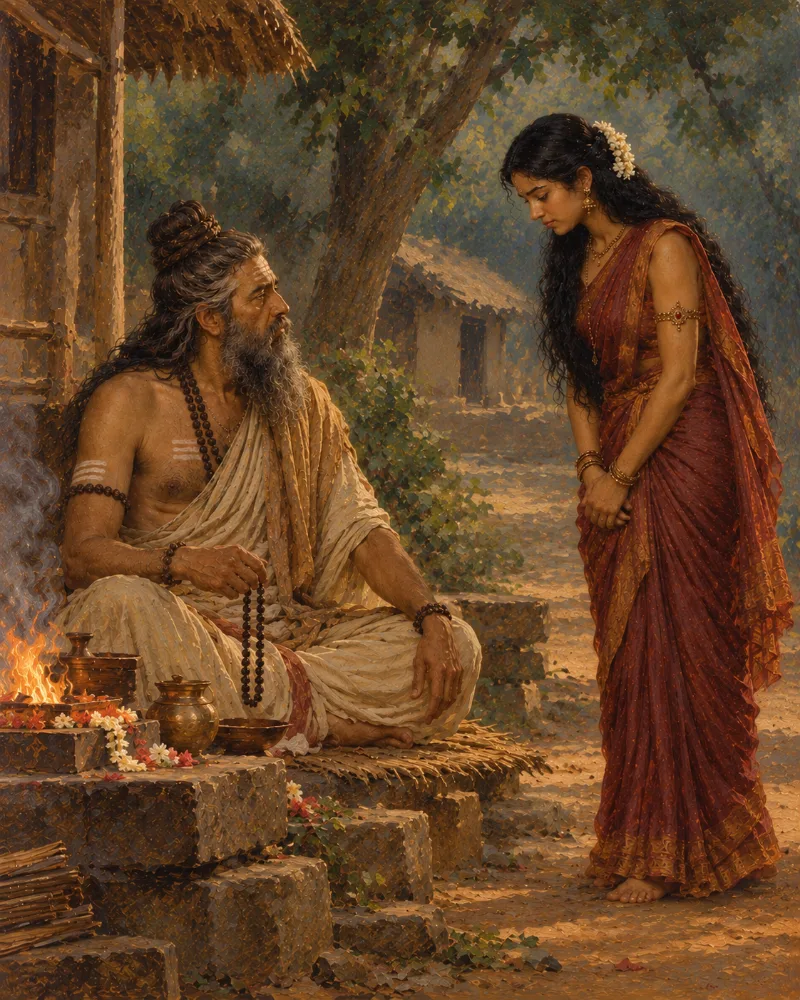
Kaikesi approached Vishrava as he sat performing a fire rite. She stood before him with her eyes cast down, scratching the ground with her toe. Vishrava asked her who she was and what she wanted. She said she was a Rakshasa princess and that her father had sent her, and that he could surely tell the rest by his own insight. Vishrava understood and agreed to her request.
Because it was evening, a fearful hour, Vishrava warned her that she had come at an inauspicious time. He told her that her sons would be cruel in nature and would terrorize others.
Kaikesi pleaded with him not to give her cruel sons only, and asked for sons who were not all like that. Vishrava relented and said that her youngest son would be righteous and of his own lineage's character. This son was Vibhishana.
The sons and daughter
Kaikesi bore four children over time.
- Ravana was born first with ten heads and twenty arms, with copper-colored lips and large teeth. The text records evil omens at his birth. Jackals howled, and meteors fell.
- Kumbhakarna was born next, a giant of great strength, known for his enormous appetite and sleep.
- Shurpanakha was the only daughter.
- Vibhishana was the youngest, and was righteous in character, as Vishrava had promised.
Valmiki does not describe their childhood in detail. The story picks up again with the sons grown up and living in the forest near their father's hermitage.
Kaikesi and Ravana's rise
The Uttara Kanda says that Kaikesi, seeing Kubera and his wealth, spoke to her son Ravana. She pointed out that Kubera, his half-brother, ruled in splendor while his own family lived in poverty. She urged him to become like Kubera or surpass him.
Stung by his mother's words, Ravana vowed to win greater power than Kubera. He and his brothers went to Gokarna and performed severe austerities for ten thousand years. Ravana offered one of his heads to the fire at the end of each thousand years, and Brahma appeared and granted boons when the tenth was about to be offered. Ravana then took Lanka and the Pushpaka from Kubera. The text presents Kaikesi's urging as the spark of the Rakshasa revival, though it does not blame her.
Sumali's family and the Rakshasa court
Several members of Kaikesi's family reappear in the Ramayana.
- Prahasta, her brother, serves as Ravana's chief minister and general. He is killed in the war.
- Malyavan, her great-uncle in the text, advises Ravana to make peace with Rama.
- Sumali is her father and Ravana's maternal grandfather. He is the origin of the plan to reclaim power.
Variants in other traditions
The Valmiki Ramayana names Kaikesi as the mother of Ravana. Other texts differ.
- Mahabharata (Ramopakhyana): The story is told to Yudhishthira in the forest by the sage Markandeya. It names Pushpotkata as the mother of Ravana and Kumbhakarna, Malini as the mother of Vibhishana, and Raka as the mother of Khara and Shurpanakha.
- Puranas: Some Puranas call Ravana's mother Nikasha.
- Khara, Dushana and Trishiras: In Valmiki, Khara and Dushana are Ravana's relatives who rule the Janasthana region. Some retellings call them Ravana's brothers, and some make them the sons of Shurpanakha. Their exact relationship to Kaikesi varies by version, so this article does not list them as her children with certainty.
What the text does not say
Valmiki does not record when or how Kaikesi died. She does not appear in the war or in Ravana's final days. Her character is also not developed beyond her role as mother and as the one who pushed Ravana toward ambition.
Significance
Kaikesi stands at the point where the Rakshasa and Brahmin lines meet in the Ramayana. Her children share the learning of the sage Vishrava and the aggression of the Rakshasa clan. This mix explains why Ravana is both a scholar and a tyrant, and why Vibhishana can choose the side of righteousness.