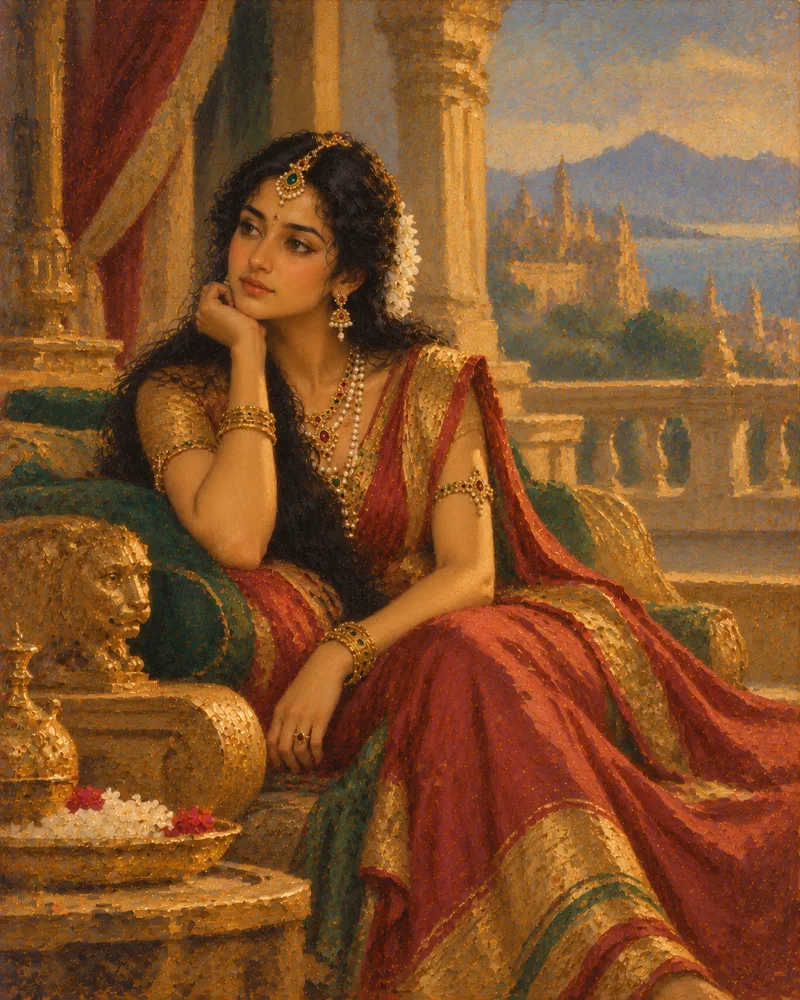
Introduction
Mandodari is the chief queen of Ravana, the daughter of the architect Mayasura and the apsara Hema. She is known for her counsel to Ravana and for her lament at his death, and is counted in later tradition among the Panchakanya ("five maidens" or "five virgins"), a group of exemplary women named alongside Ahalya, Draupadi, Kunti and Tara.
This article primarily follows the Valmiki Ramayana. Where a well-known detail comes from a later retelling or tradition, the article identifies it.
Family
- Father: Mayasura
- Mother: Hema
- Husband: Ravana
- Sons: Meghanada, Akshayakumara
Parentage
According to the Uttara Kanda, Mandodari was the daughter of Maya, the Danava architect, and the apsara Hema. She and Ravana had sons including Meghanada (Indrajit) and Akshayakumara.
Advice to Ravana
Mandodari repeatedly advised Ravana to return Sita. She warned him that Rama was no ordinary man and that the abduction would destroy him -- advice he repeatedly set aside, in a pattern the epic uses to contrast her wisdom with his fatal pride.
The lament
After Ravana's death, Mandodari came to the battlefield, and Valmiki gives her a long lament. In it she speaks of his greatness and of his own choices as the cause of his end, questioning why a king desired by the greatest apsaras had fallen for an ordinary mortal woman.
In later tradition
A widely cited later tradition, found outside Valmiki's text, holds that after Ravana's death Vibhishana, now crowned king of Lanka, married Mandodari as his queen -- read in these retellings as both a political necessity to stabilize the kingdom and an honor shown to a widow regarded as blameless in her husband's wrongdoing. Her standing as one of the Panchakanya in later Hindu tradition reflects this same reputation for personal virtue despite her marriage to a figure the tradition otherwise condemns.