Introduction
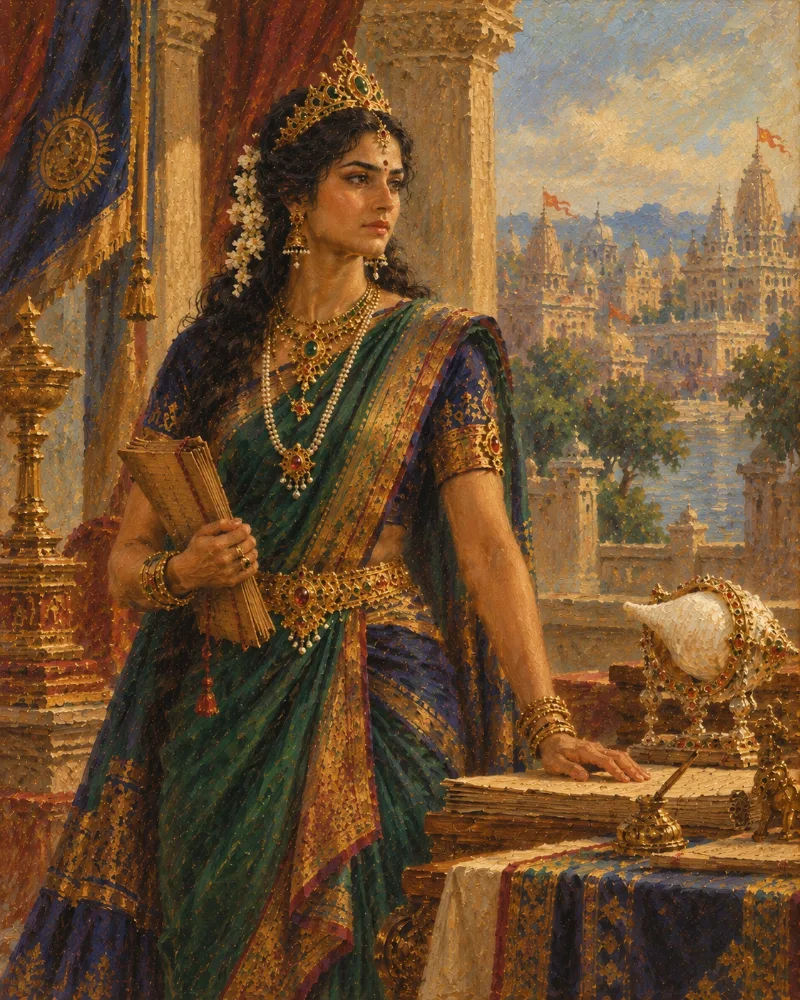
Mandavi is the daughter of Kushadhwaja, the younger brother of King Janaka, and the cousin of Sita. She married Bharata in the joint wedding of the four brothers at Mithila.
This article primarily follows the Valmiki Ramayana. Where a well-known detail comes from a later retelling or tradition, the article identifies it.
Family
- Father: Kushadhwaja
- Mother: Kushadhwaja's wife (unnamed in Valmiki)
- Husband: Bharata
- Siblings: Shrutakirti
- Sons: Taksha, Pushkala
The joint wedding at Mithila
When King Janaka arranged the marriage of his daughters Sita and Urmila to Rama and Lakshmana, his brother Kushadhwaja's daughters Mandavi and Shrutakirti were married in the same ceremony to Bharata and Shatrughna respectively -- a single joint wedding of the four Ayodhya princes to the four Mithila princesses, a scene often depicted in art and retellings as a moment of complete familial union between the two kingdoms.
Marriage and children
According to the Uttara Kanda, Mandavi and Bharata had two sons, Taksha and Pushkala, who later ruled the cities of Takshashila and Pushkalavati respectively -- cities whose names tradition connects to these sons, in the region of ancient Gandhara.
Fourteen years
Like her sister-in-law Urmila, Mandavi remained in Ayodhya during Rama's fourteen years of exile, while her husband Bharata withdrew to Nandigrama, living as an ascetic and ruling the kingdom in Rama's name, placing Rama's sandals on the throne as a sign that he held the kingdom only as regent.