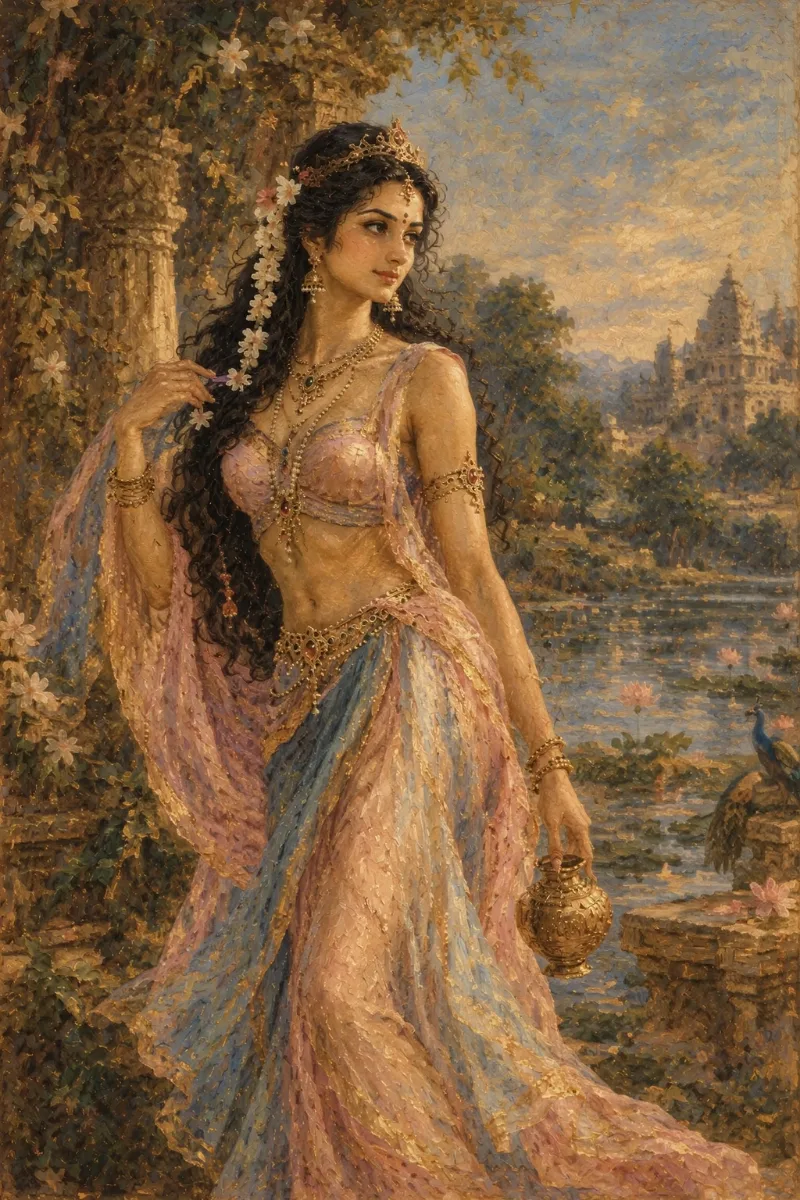
Introduction
Menaka is an apsara, a celestial dancer of Indra's court, and the mother of Shakuntala. She is known for breaking Vishwamitra's penance.
This article primarily follows the Mahabharata, where Menaka's story appears in the Adi Parva as part of Vishwamitra's biography. Where a detail comes from the Valmiki Ramayana or a later retelling, the article identifies it.
Family
- Husband: Vishwamitra
- Daughter: Shakuntala
Breaking Vishwamitra's penance
When Vishwamitra began his great austerities, Indra felt threatened by the power he was accumulating. Menaka was considered the most beautiful of the apsaras. Indra sent her to Vishwamitra's hermitage, with the wind-god Vayu as an unseen ally — the wind scattered her garments as she approached the meditating sage. Vishwamitra was distracted. He and Menaka lived together for ten years, though to Vishwamitra the time passed as if in a moment. When he returned to awareness and realised how long he had been away from his penance, he dismissed her without cruelty or curse. She wept as she returned to Indra's court.
The Valmiki Ramayana mentions that Vishwamitra had earlier been provoked by the apsara Rambha and cursed her to stone for ten thousand years — with Menaka he was less angry, perhaps because she had wept and was not blamed for her mission.
Shakuntala
Menaka bore a daughter and left her in the forest near the hermitage of the sage Kanva on the river Malinī. The girl was tended by shakunta birds — from which she took her name, Shakuntala. Kanva raised her as his own daughter. The Mahabharata tells her full story in the Adi Parva: she later met and fell in love with king Dushyanta, became the mother of the emperor Bharata, and is thus an ancestor of both the Kauravas and Pandavas. The epic is sometimes called the Bharata, in part, after Bharata her son. Kalidasa's Sanskrit play Abhijñānaśākuntalam, which follows a later tradition where Dushyanta forgot Shakuntala due to a sage's curse before remembering her through a ring, is the most famous literary retelling of her story.
Legacy
Menaka is a figure of ambivalence in the tradition — she succeeded in her task for Indra, but is not condemned for it. In several retellings she is said to have loved Vishwamitra and to have been heartbroken to leave. She embodies the intersection of divine duty, earthly attachment, and the power of tapas.